Demande

The Controller Area Network (CAN) in automotive testing
CAN hardware from GÖPEL electronic
Our automotive multibus controllers fully cover CAN, CAN-FD and the latest development of CAN-XL. Typical applications are ECU tests and residual bus simulations. Diagnostic protocols, network management, XCP, SecOC and other higher protocols are available on the controllers as onboard functions.
No matter whether PXI/PXIe, PCI/PCIe or stand-alone device: In our portfolio you will also find a suitable CAN controller for your application!
CAN-XL - the third development
CAN-XL is practically the third development stage of the CAN bus, the transmission principle is largely identical to CAN-FD. The user data rate has been further increased and can be up to 10 Mbit/s. The bit rate increase in the user data area, which was still optional with CAN-FD, is obligatory with CAN-XL. The decisive advantage of this CAN interface, however, is the significantly increased number of user data that can be transmitted per frame (1..2048 bytes). It is therefore possible to transport Ethernet frames via CAN-XL.
Controller Area Network - CAN
A CAN bus system is comparatively cheap and can be easily expanded. A new component (i.e. another control unit, for example) can simply be inserted into the existing CAN bus by connecting to the bus lines. If a component fails, this has no effect on the other CAN bus components, which can continue to communicate with each other without restriction. Another important advantage is the interference immunity. It is based on a twisted pair bus; information is mapped on both lines simultaneously with an opposite change in potential (differential signal). The maximum data rate is 1Mbit/s, a CAN frame can contain up to 8 bytes of user data.
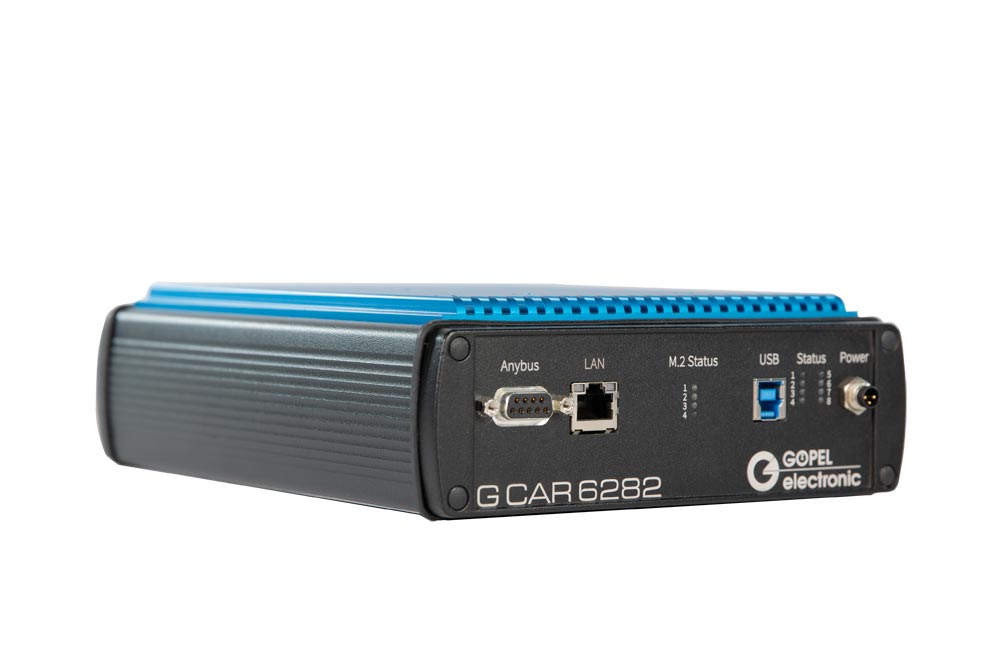
Series 62 high-end Multibus Controller with flexible channel configuration
the high-end standalone box G CAR 6282
- restbus simulation and test of complex control units
- maximum 18 Automotive interfaces in different configurations (CAN FD / LIN / Ethernet)
- with extension board 48 I/O interfaces (16 Digital In, 16 Digital Out, 8 Analogue In, 8 Analogue Out)
- execution of onboard programs in a 64 bit real-time operating system
- performant Flash programming of control units
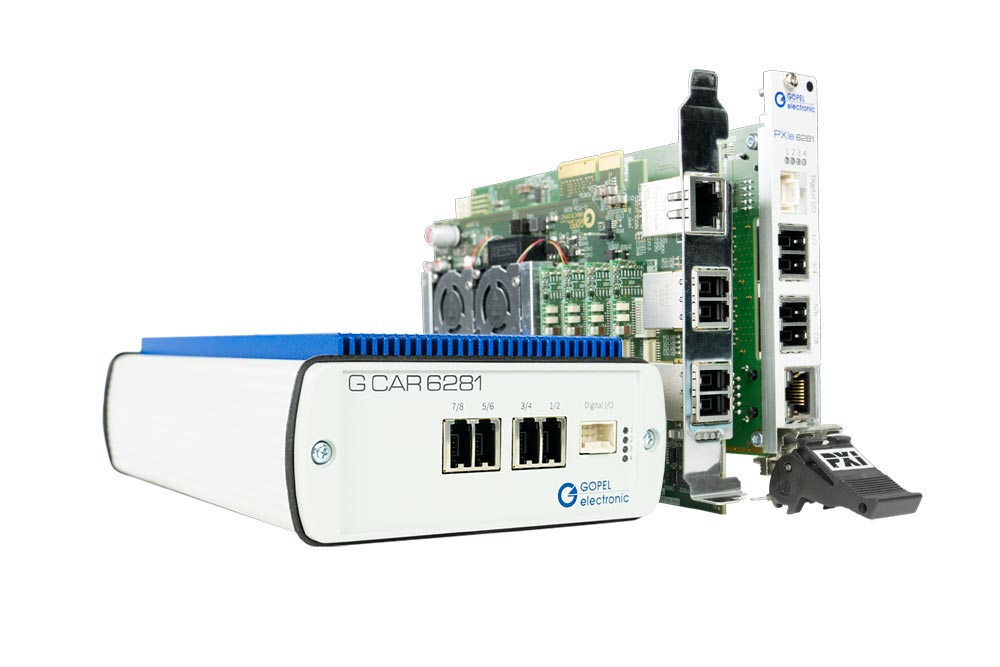
Highlights of the Series 62 Multibus Controller
G PCIe 6281 / G PXIe 6281 / G CAR 6281
- available as PXI/PCI Express and standalone box
- use for CAN/CAN-FD/LIN/K-Line and FlexRay applications and automotive test systems
- use for restbus simulationen und testing technology in the automotive area, test of complex control units
- maximum 8 automotive interfaces in different configurations (CAN FD / LIN / FlexRay / Ethernet)
- optionally up to 2 FlexRay / 100/1000Base-T1 interfaces
- up to 8 conventional signals (Digital In / Digital Out)
- execution of onboard programs in a 64 bit real-time operating system
- performant Flash programming of control units